

When employees ask for mentoring, what are they really asking for?
It’s a question many Talent Development and People & Culture leaders are grappling with. In our recent webinar, Impactful Workplace Conversations: Unlocking Culture and Connection, we explored what sits beneath that simple request.
After 20 years of running structured mentoring programs, one insight stands out — mentoring requests are rarely as simple as they first appear.
Generally, requests for mentoring fall into one of these four key ‘needs’ areas.
- Career progression
- Navigating organisational ambiguity
- Skill development
- Inclusion and belonging
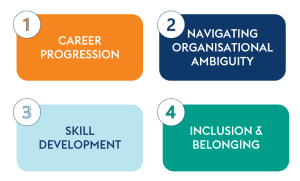
Understanding which of these needs is driving the request, is the critical element in determining how to best design your program to achieve the maximum impact. In this article we will explore each area of need and explain the type of program to best meet those needs.
Before we do so, the three program types which sometimes overlap, and often get used interchangeably are mentoring, coaching and sponsorship programs. These are indeed three very different and distinct types of programs, each with their own approaches to address differing needs and requests.
The three can be defined as follows:
Mentoring Programs:
Structured development partnerships where a more experienced professional provides guidance, perspective and confidence-building support to help an individual clarify and achieve their goals and navigate their career.
Coaching Programs:
Focused, goal-driven partnerships designed to build a specific capability, where the coach uses structured questioning and reflection to help the individual embed new skills and behaviours.
Sponsorship Programs:
Advocacy-based partnerships where a senior leader not only provides guidance but actively uses their influence and networks to create opportunities and progress an individual’s career.
Now that our definitions are clear, lets explore the four needs areas and which program type(s) best suit those needs.
1. CAREER PROGRESSION: “Help Me Move Forward”
For many employees, mentoring is about growth.
And if this need for growth is not being met, they may be experiencing:
- Lack of clarity around growth opportunities
- Limited mobility within the organisation
- A perceived lack of advocacy
- Self-doubt about stepping into the next role
We consolidated application data of 125 participants across 4 of our 2025 industry-based programs to determine the most common goals for participants in the program. The top three goals for mentees were:
- Accelerating leadership development
- Pursuing next role and looking for help in getting there
- Clarifying career path and determining what is right for me.
Some individuals need a mentor to build confidence, refine their personal brand, and clarify their direction. Others are ready for sponsorship — someone who will actively advocate for them in talent conversations and open doors when they are not in the room.
If the real barrier is visibility and influence, mentoring alone may not shift the dial, however sponsorship may be the bridge that is needed to break down those barriers.
The question for HR leaders becomes:
Is this about capability, confidence, or access?
Designing with that clarity ensures the program delivers real mobility, not just good conversations.
Capability and confidence can be enhanced by mentors from different functional or regional areas than their mentee, provided they have had to develop the same capabilities themselves. They can share their personal journey and play a critical role in supporting their mentee to grow. If mentees are clear about their career path ahead and if they already have access to senior networks but struggle to progress, they probably need sponsorship. In that case, sponsors should be in the same functional line as their sponsees, and at least 2 levels up in seniority.
2. NAVIGATING ORGANISATIONAL AMBIGUITY: “Help Me Make Sense of This”
In complex, transforming organisations, employees often feel they are operating without context.
They may not say it directly. Instead, it sounds like:
- “I don’t understand how decisions get made.”
- “I don’t feel connected to the bigger picture.”
- “Change is happening too fast, and I feel under prepared and uninformed.”
In reality, they are asking for sense-making.
This isn’t necessarily about progressing to the next role. It’s about being more effective in the current one.
In these cases, matching mentees with diverse mentors across functions or regions can be powerful. Exposure to different perspectives broadens understanding and builds strategic awareness.
Sometimes what people need is not a more senior mentor, but a different lens.
We’ve seen global programs significantly increase participants’ confidence in navigating complexity and cultural nuance. When employees feel clearer about how the organisation works, performance and engagement follow.
So ask:
Are they seeking advancement or clarity? If clarity is the answer, then a mentoring program will provide them with the support needed to navigate the system.
3. SKILL DEVELOPMENT: “Help Me Close the Gap”
Some mentoring requests stem from a capability gap.
Employees may express:
- Lack of feedback or guidance
- Desire for tailored development
- Need for shadowing or exposure
In these cases, we need to be careful not to confuse mentoring with coaching.
If the need is technical or knowledge-based, short, targeted “flash mentoring” may work. A single conversation can unlock insight.
But if the goal is to develop influencing skills, strategic thinking, or the ability to build high-performing teams, a longer-term coaching-style partnership is more effective. These capabilities require reflection, practice, and behavioural shifts.
Our consolidated data shows us that the three top capabilities mentees are particularly focused on are:
- Driving strategy
- Building high-performing teams
- Broadening perspective
These are not skills developed through advice alone. They are built through structured dialogue, feedback, and supported stretch.
To make the experience even more impactful for participants, diagnostic 360 assessment tools can help to identify areas for the participants to work on during the program. Oftentimes there are skills that a person may be missing, which they’re completely unaware of. This is where 360 assessments are helpful to bring to the surface insights from peers, direct reports and more senior colleagues. These assessments often complement coaching, mentoring and sponsorship programs to enrich them event further.
The design question here is:
Are we solving for technical skill development, or leadership growth and transformation?
4. INCLUSION AND BELONGING: “Help Me Thrive Here”
The fourth theme is often the least explicitly stated.
Employees from underrepresented identity groups may not say, “I need advocacy.” Instead, they might describe:
- Feeling lost
- Lacking connection
- Missing informal support their peers seem to receive organically
- Limited visibility with senior leaders
What they are often missing is organic sponsorship.
In many organisations, advocacy happens informally. Leaders take people under their wing. They recommend them in succession discussions. They create stretch opportunities.
But not everyone has equal access to those informal networks.
Structured mentoring and sponsorship programs can level the playing field. But only if designed intentionally.
Importantly, these programs must work at two levels:
- Supporting mentees and sponsees
- Developing inclusive leadership capability in mentors and sponsors
By analysing Inclusion360 data gathered from 378 survey responses in a single, industry-based program in 2025, we consistently saw that the areas participants were rated lowest included personal awareness, openly discussing how stereotypes and biases may impact judgement, and challenging behaviours that exclude people from participating fully. This highlights an opportunity.
When mentoring programs intentionally build inclusive leadership capability, they create systemic change, not just individual advancement.
The design question becomes:
Are we supporting individuals, or shifting the system?
Leveraging a tool like Inclusion360 within a mentoring or sponsorship program can create a foundation which can develop inclusive leadership capability of ALL participants.
THE IMPORTANCE OF EVALUATION
One of the most powerful insights from the webinar was this: clarity of purpose drives measurable impact.
Before launching a program, ask:
- What will be true in six months that is not true today?
- What strategic objective does this support?
- How will we measure success?
When evaluation is built in from the start, the results are significantly more meaningful. Some suggested areas for measurement can include:
- Clarity of career goals
- Confidence in leadership capability
- Strategic direction for progression
- Shifts in inclusive leadership behaviours
Evaluation survey data not only validates the program’s value for individuals, it strengthens internal culture and secures continued leadership support.
Designing with Intent
Mentoring is not a one-size-fits-all solution. When employees ask for mentoring, they may be asking for:
- Confidence
- Context
- Capability
- Connection
If we respond with a generic program, we risk disappointment and worse, disengagement. But when we take time to understand the underlying need, mentoring becomes far more than a development initiative.
It becomes a lever for culture.
For HR and People & Culture leaders, the opportunity is clear: Pause before you design. Ask more questions and be curious about ‘why’. Be clear on your understanding of mentoring, coaching and sponsorship. And lastly, measure what matters.
Because impactful workplace conversations don’t just happen. They are designed.
And when designed well, they unlock clarity, capability and connection at scale.
_____________________________
Watch our webinar on this very topic and learn which program will best meet the needs of your team.